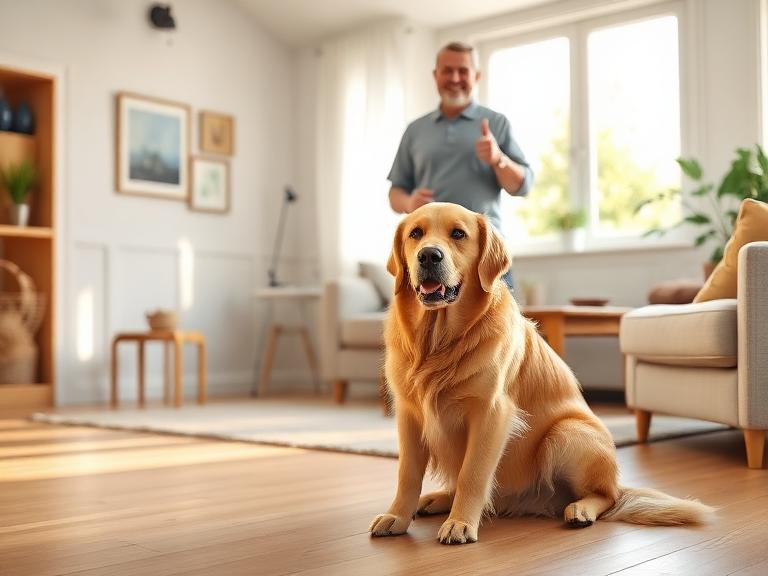
A familiar scenario unfolds in countless homes across North America: a guest arrives at the front door, and before a proper greeting can be exchanged, the family dog launches itself upward, placing its paws on the visitor’s clothing or body. The owner reacts with verbal commands such as “Down!” or “Off!” while attempting to restrain the enthusiastic pet, often resulting in embarrassment and frustration for all parties involved.
This behaviour is not an indication of a disobedient or aggressive dog. Rather, jumping on guests is a natural expression of excitement and a desire for social engagement. Nevertheless, for many households in the United States and Canada, this habit can transform ordinary social visits into stressful encounters, particularly when children, elderly individuals, or guests who are uncomfortable with dogs are present.
The encouraging news is that permanent resolution of this issue does not require isolating the dog every time the doorbell rings. Through consistent application of evidence‑based training techniques and a clear understanding of canine behaviour, owners can teach their dogs that keeping all four paws on the floor is the most rewarding way to greet visitors. This article provides a comprehensive, step‑by‑step approach to achieving calm, polite greetings.
Understanding the Root Cause of Jumping Behaviour
Before implementing corrective measures, it is essential to understand why dogs jump on people. From a canine perspective, jumping is a normal and effective method of greeting. When dogs meet one another, they naturally approach face‑to‑face to exchange olfactory information. Since humans are significantly taller, a dog’s leap is simply an attempt to reach a human’s face for a similar greeting.
Jumping is classified as a high‑arousal behaviour. It is typically driven by excitement, a demand for attention, or, in some cases, mild anxiety. One critical insight for owners is that any reaction from a human—including pushing the dog away, shouting “no,” or making eye contact—may inadvertently reinforce the behaviour. For a dog, any form of attention (negative or positive) can serve as a reward. Consequently, the dog learns that jumping results in engagement, and the behaviour persists. Recognising this dynamic is the first step toward effective modification.
Immediate Action Plan for Day‑to‑Day Management
For owners who wish to begin training immediately, the following three‑step protocol, derived from professional dog training recommendations, can be implemented without delay.
1. The Withdrawal of Attention
When the dog jumps, the owner should instantly become uninteresting. Turn your back, cross your arms, and direct your gaze toward the ceiling. Avoid eye contact, verbal communication, and physical touch. Continue this posture until all four of the dog’s paws are resting on the floor.
2. Reinforcement of Desired Behaviour
The moment the dog’s paws touch the ground, the owner should deliver calm verbal praise and a small, high‑value treat. This immediate reinforcement teaches the dog that being on the floor—not jumping—produces positive outcomes.
3. Environmental Management
To prevent the dog from repeatedly practicing the unwanted behaviour, owners should use physical controls during the training period. A baby gate can confine the dog to a separate area before guests arrive, or a short leash can provide the owner with direct control. These measures are not punishments; they are strategic tools that set the dog up for success.
Detailed Training Protocol for Long‑Term Success
Consistency remains the most critical factor in modifying jumping behaviour. The following step‑by‑step plan provides a structured approach to achieving reliable, polite greetings.
1. Enforce the “Four on the Floor” Rule
This principle must become the foundation of all human‑dog greetings. Under no circumstances should a jumping dog receive attention. Owners and all family members should practice the “ignore and turn” method every time the dog jumps. Although this may feel awkward initially, it is the most powerful tool available. For large breed dogs, strict adherence to this rule is especially important to prevent accidental injury to guests.
2. Teach an Incompatible Behaviour
A dog cannot simultaneously jump and sit. Therefore, owners should train a default greeting behaviour: the sit. Begin practicing in low‑distraction environments. Ask a family member to approach the dog. Just before the person reaches the dog, issue a “sit” command. Reward generously. Over time, the dog will learn that sitting is the reliable method for unlocking attention and treats from new people.
3. Develop Impulse Control with the “Focus” Game
Dr. Colleen Fisher, a veterinarian, recommends a simple but effective game for reducing overexcitement. Place a treat inside a closed fist and hold it directly in front of the dog’s nose. The moment the dog stops nibbling at the hand and makes eye contact, say “Yes” and release the treat. This exercise teaches the dog that calm, focused behaviour is highly rewarding and helps build general impulse control.
4. Establish a “Place” Cue Near the Entrance
Teach the dog to go to a designated bed or mat on command, using the cue “Place.” When the doorbell rings or a knock occurs, send the dog to its place. Once guests have entered and removed their coats, release the dog for a calm greeting. If the dog jumps at that point, the guest should calmly turn away until the dog settles.
Collaborating with Guests for Consistent Training
Visitors to the home can either accelerate or undermine training progress. Owners should not hesitate to provide clear instructions before guests cross the threshold. A simple message or brief verbal reminder is sufficient: “We are currently training a new greeting behaviour. Please ignore the dog until he sits. If he jumps, please turn your back. Thank you for your cooperation.”
This polite request prevents well‑meaning friends from accidentally reinforcing jumping through excited squeals or enthusiastic petting.
Practical Daily Hacks for a Calmer Home Environment
Beyond formal training sessions, several everyday strategies can significantly reduce jumping incidents.
- Prioritise Pre‑Visit Exercise. A tired dog is more likely to remain calm. A long walk or a vigorous game of fetch shortly before guests arrive lowers the dog’s baseline arousal level, making it substantially easier for the dog to follow commands.
- Use the Treat Toss Technique. Keep a small bowl of treats near the front door. As the owner or a guest enters, toss a handful of treats onto the floor away from the entryway. While the dog is occupied with sniffing and consuming the treats, the humans can exchange greetings without interference.
- Place Jumping on a Cue. If a family member secretly enjoys the dog’s jumping, the behaviour can be brought under stimulus control. Teach a specific “Up” cue for jumping on command, and a distinct “Off” cue to stop. This approach teaches the dog that jumping is permitted only when explicitly invited, not as a default greeting.
FAQs:
Q: How long does it typically take for a dog to stop jumping on guests?
A: With consistent application of the techniques described above by all members of the household, most dogs demonstrate noticeable improvement within two to four weeks. For dogs with a long‑standing habit, the process may require additional time. Patience and consistency remain essential.
Q: What should I do if my dog becomes too excited to respond to commands?
A: This response indicates that the training environment is too challenging. Take a step back. Increase the distance between the dog and the guest, or place a physical barrier (such as a baby gate) between them. Practice at a distance where the dog can remain calm, then gradually reduce the distance over multiple sessions.
Q: Is it acceptable to knee a dog in the chest to stop jumping?
A: No. This method is outdated and potentially dangerous. Physical corrections can cause injury, damage the human‑animal bond, and provoke fear‑based aggression. All training should be based on positive, force‑free principles.
Q: How do I train multiple dogs simultaneously?
A: Train each dog individually before combining them. Work with one dog at a time on the “four on the floor” rule. Once each dog has mastered the skill separately, practice with both dogs together while each is on a separate leash under the owner’s control.
Q: Does jumping matter if my dog is very small?
A: Yes. Even a small dog that cannot physically knock over a guest still exhibits poor manners. Jumping can annoy guests and frighten individuals who are not comfortable with dogs. Calm greetings should be trained regardless of the dog’s size.
Modifying a dog’s jumping behaviour is fundamentally about changing the way owners, family members, and guests interact with the dog. The process requires time and collective effort, but the resulting benefits are substantial. Imagine a household where the doorbell rings and the dog calmly looks to its owner for guidance, or where social gatherings occur without a physical struggle at the entrance. These outcomes are entirely achievable.
By applying the principles outlined in this guide—understanding canine motivation, withholding attention for jumping, rewarding calm behaviour, managing the environment, and enlisting the cooperation of guests, any owner can teach their dog the valuable skill of a polite, four‑paws‑on‑the‑floor greeting. Begin today with patience and consistency. Your well‑mannered dog awaits.